2027 Essential Education GED & HiSET Learner Report
Original Research on Who Today's Adult Learners Are, How They Prepare, and What Comes Next
Every year, thousands of adults begin preparing for the GED or HiSET exams. But what do we really know about the people behind those enrollments? Why are they returning to education? What challenges are they facing? And what are they hoping to accomplish once they earn their credentials?
For some, the goal is a better job or a new career. Others want to attend college, enter a career training program, improve their financial situation, or finally accomplish something they've wanted to do for years.
Just as their reasons for returning to education differ, so do their experiences. Some adults begin preparing shortly after leaving high school, while others haven't stepped into a classroom in decades. Many are balancing their studies with jobs, family responsibilities, and the demands of everyday life.
The 2027 Essential Education GED & HiSET Learner Report presents original research based on aggregated learner data from Essential Education's GED Academy and HiSET Academy programs, along with survey responses from current and prospective adult learners. The report explores learners' educational experiences, motivations, challenges, preparation needs, and future goals, providing a closer look at the adults working toward earning their GED or HiSET.
This is the first edition of an annual research report designed to provide educators, workforce organizations, and others supporting adult learners with a better understanding of the people pursuing high school equivalency credentials.
Key Findings From Essential Education's Research
|
71% At the beginning of preparation Among 93,888 learner responses, 70.8% indicated they had not started studying or had studied only a little toward earning their GED or HiSET credential. |
55% Seeking better employment Among 74,733 learner responses, 55.1% identified getting a better job as one of their reasons for pursuing a high school equivalency credential. |
|
47% Concerned about time away from school Among 92,118 learner responses, 46.9% identified having been out of school for a long time as their biggest challenge in preparing for a GED or HiSET credential. |
67% Expect math to require the most preparation Among 602 survey records, 66.8% identified mathematics as the subject they expected would require the most preparation before taking their GED or HiSET exam. |
|
44% Want a practice or placement test Among 602 survey records, 44.4% selected a practice or placement test as something that would help them understand their current skills and feel more prepared to begin studying. |
62% Ready for their next step Among 602 survey records, 61.8% hoped to begin their next education or career step immediately or within three months of earning their GED or HiSET credential. |
These findings show that preparing for a high school equivalency credential involves more than academic instruction. Learners bring different educational histories, responsibilities, levels of confidence, and goals for the future.
By better understanding these experiences, we can make more informed decisions about how to support learners, improve instruction, and help more adults succeed.
Table of Contents
- Who Is Today's High School Equivalency Learner?
- Where Are Learners When They Begin?
- Why Are Adults Pursuing a GED or HiSET Credential?
- What Challenges Do GED and HiSET Learners Face?
- Confidence and Readiness to Begin
- How Quickly Do Learners Hope to Earn Their Credential?
- How Do GED and HiSET Learners Study?
- What Comes After Earning a GED or HiSET?
- What the Research Means for Adult Education
- About the Research
- About Essential Education
1. Who Is Today's High School Equivalency Learner?
Adults pursuing a GED or HiSET credential come from different educational backgrounds and stages of life.
Some are continuing their education shortly after leaving high school, while others are returning after years or even decades.
Essential Education's research provides a closer look at these differences, including how long learners have been away from school and whether they have attempted to earn their credential before.
How Long Have Learners Been Away From School?
Among 602 survey records, 26.6% indicated they were currently enrolled in school, while another 10.8% had been out of school for less than one year.
However, a substantial portion reported much longer gaps in their education.
| Time since last enrolled | Percent |
| Currently | 26.6% |
| Less than 1 year | 10.8% |
| 1 to 2 years | 12.1% |
| 3 to 5 years | 13.1% |
| 6 to 10 years | 10.3% |
| 11 to 20 years | 14.0% |
| More than 20 years | 13.1% |
37.4% of respondents had been away from school for six years or longer.
This includes 13.1% who had not attended school in more than 20 years.
These findings show that high school equivalency preparation serves adults with very different educational histories. Some are continuing their education with relatively little time away, while others are returning after a significant portion of their adult lives.
Have Learners Attempted Their Credential Before?
For many adults, preparing for a high school equivalency credential is not their first attempt.
Among Essential Education learners who answered this question,
51.2% reported having previously tried to earn their credential.
48.8% were pursuing it for the first time.
This nearly even division shows that a substantial portion of learners are returning to a goal they have pursued before.
Although the data does not explain why previous attempts were interrupted, it demonstrates that earning a credential is not always a continuous process. For some adults, it involves returning to education and making another attempt to complete what they started.
Together, these findings establish an important part of the learner experience. Adults begin GED and HiSET preparation with different educational histories, and those differences can influence the support they need.
2. Where Are Learners When They Begin?
Returning to a high school equivalency goal does not necessarily mean returning near the finish line.
Essential Education analyzed 93,888 learner responses about their current stage of preparation.
The findings show that most respondents were still in the early stages of studying.
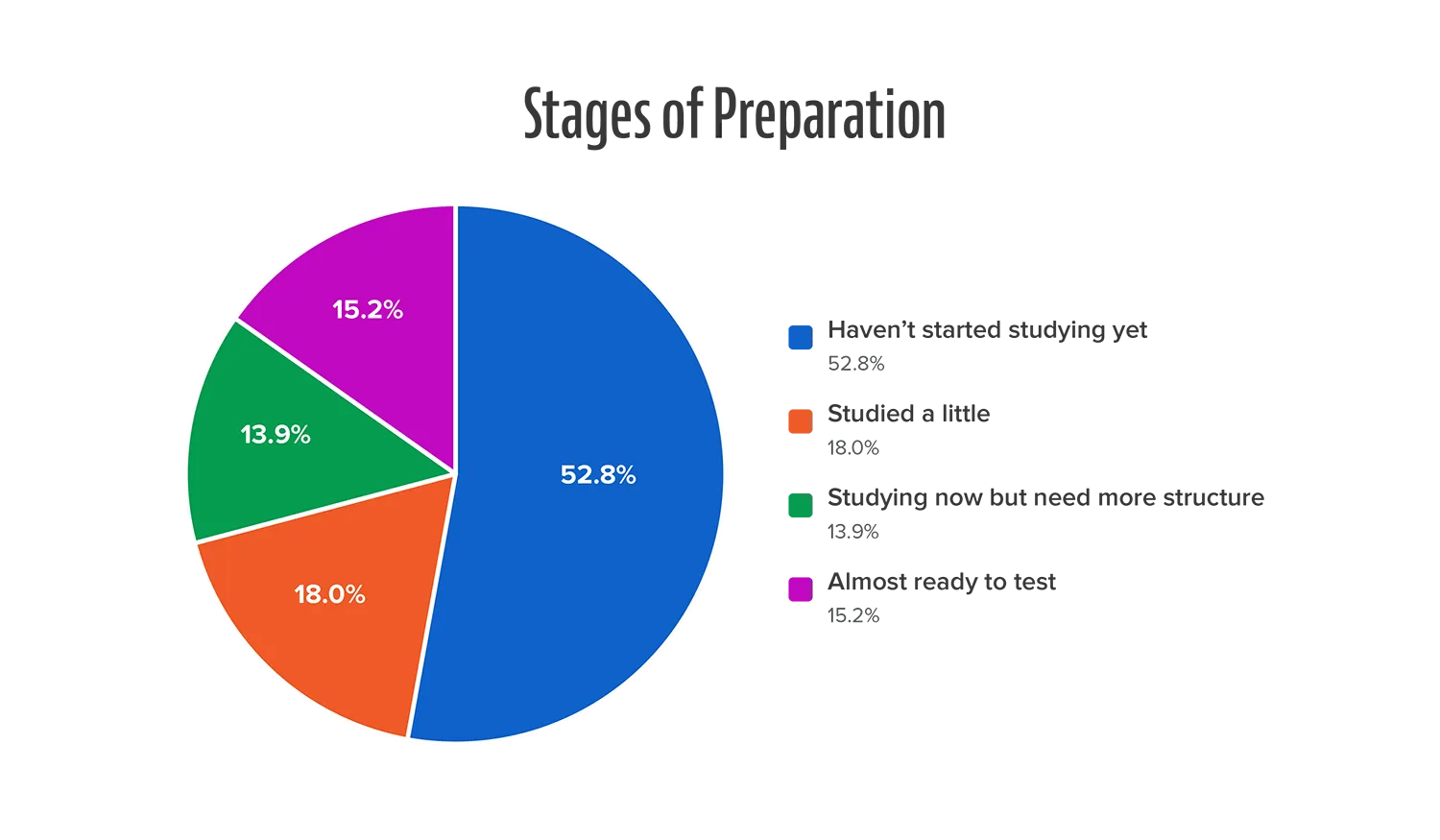
Source: Essential Education learner responses, n = 93,888. Percentages may not total 100% due to rounding.
70.8% of learners reported that they had either not started studying or had studied only a little.
This finding is especially interesting when considered alongside the number of learners who have attempted to earn their credential before.
Although many adults have pursued the goal previously, a large portion still describe themselves as being near the beginning of their current preparation.
This reinforces the importance of identifying what learners already know and what they need to work on before beginning instruction.
A learner who has previously studied for the GED or HiSET may have developed valuable skills, even if they have not yet earned their credential. Understanding those existing skills can help educators provide more appropriate instruction and avoid unnecessary repetition.
3. Why Are Adults Pursuing a GED or HiSET Credential?
The reasons adults pursue a high school equivalency credential extend beyond completing their education.
Over a five-year period, 74,733 Essential Education learners shared their reasons for pursuing a GED or HiSET credential.
The two most frequently selected motivations were personal accomplishment and employment opportunity.
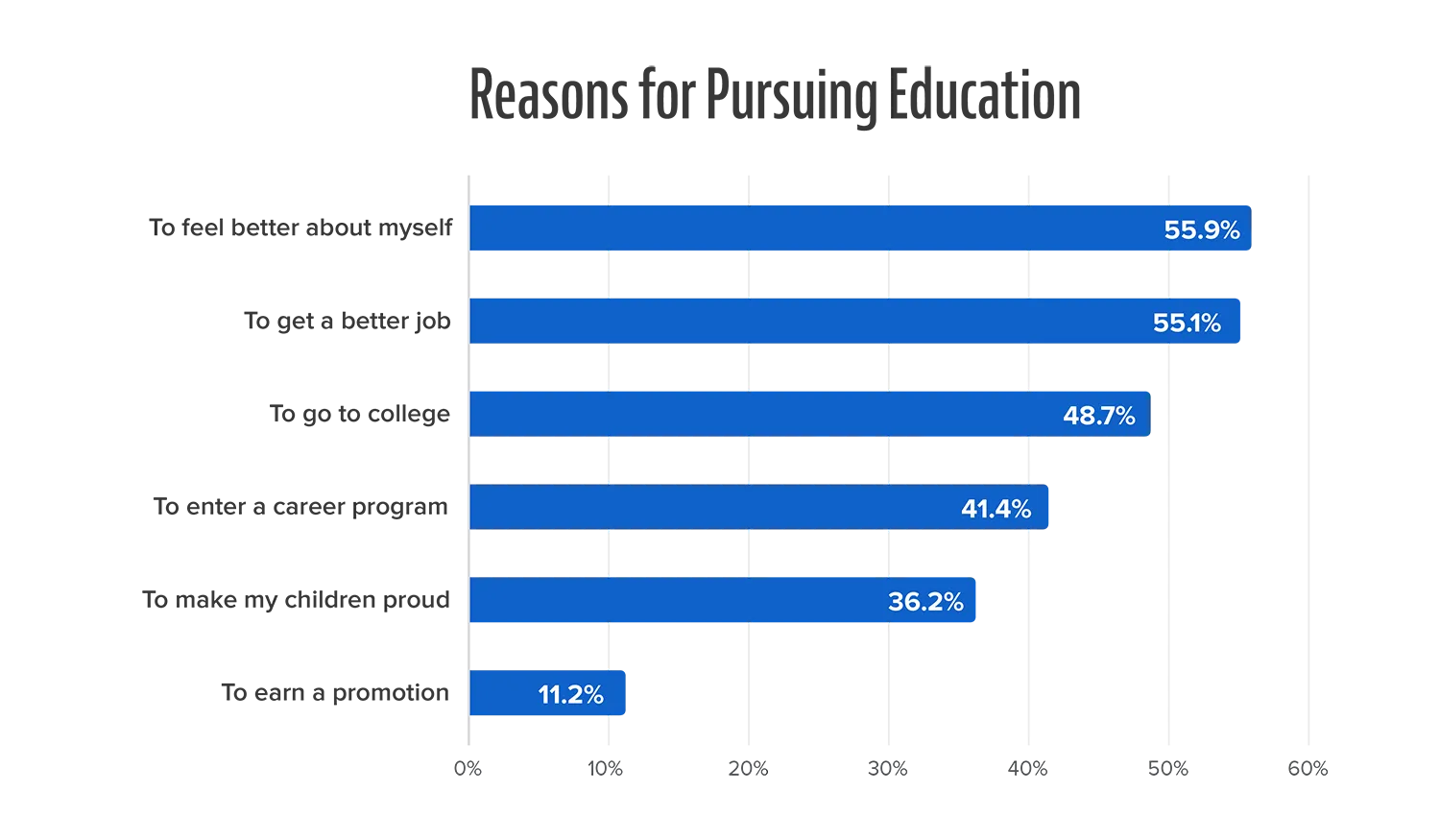
Source: Essential Education learner responses, n = 74,733. Learners could select more than one reason, so percentages do not total 100%.
The findings show how closely personal goals and economic opportunities are connected.
More than half of respondents wanted to feel better about themselves, while nearly the same percentage hoped to qualify for a better job.
Continued education was another major motivation. Nearly half wanted to go to college, while 41.4% hoped to enter a career training program.
Family also played an important role, with 36.2% selecting the desire to make their children proud.
What Do Learners Say in Their Own Words?
Essential Education's latest survey asked adults what earning a GED or HiSET credential would make possible that was not possible today.
Rather than simply identifying their reasons for pursuing a credential, learners described what they hoped would change in their lives once they earned it.
Some described opportunities they had already encountered but could not pursue because they lacked a high school credential. Others talked about wanting to return to school, qualify for a specific career, or improve their family's circumstances.
One respondent described what earning a credential would mean:
"A better career opportunity and a sense of personal pride."
Another shared a goal that was about more than personal achievement:
"A better future for me and my babies."
And one learner described a very practical goal:
"A good paying job with benefits."
These responses add an important perspective to the survey findings. While the percentages identify the most common motivations, learners' own words help explain what those goals mean in their everyday lives.
For some, earning a credential represents access to an opportunity they have already been denied. For others, it means having more choices about their education, employment, and future.
4. What Challenges Do GED and HiSET Learners Face?
Adults returning to education can encounter challenges that extend beyond understanding academic material.
When 92,118 Essential Education learners identified their biggest challenge, one response stood out.
46.9% said they had been out of school for a long time.
Other frequently reported challenges included not knowing where to begin, having limited study time, and difficulty staying motivated.
| Biggest challenge | Percent |
| I’ve been out of school a long time | 46.9% |
| I don’t know where to start | 13.7% |
| I don’t have a lot of time to study | 11.3% |
| I have trouble staying motivated | 11.1% |
Source: Essential Education learner responses, n = 92,118. The four most frequently reported challenges are shown.
The findings show that time away from education is a significant concern for many learners.
This is consistent with Essential Education's latest survey, in which 37.4% of respondents reported being away from school for six years or longer.
Returning after an extended absence can mean becoming familiar with current testing requirements, refreshing academic skills, and adjusting to studying again.
However, time away from school is not the only challenge.
Learners also described uncertainty about their academic abilities, testing anxiety, and difficulty balancing education with other responsibilities.
These experiences highlight why adult education programs need to consider both academic preparation and the circumstances that may affect a learner's ability to begin and continue studying.
5. Confidence and Readiness to Begin
Confidence can influence how adults approach returning to education, but feeling confident does not necessarily mean feeling academically prepared.
Essential Education's latest survey asked learners how confident they felt about returning to learning after time away from school.
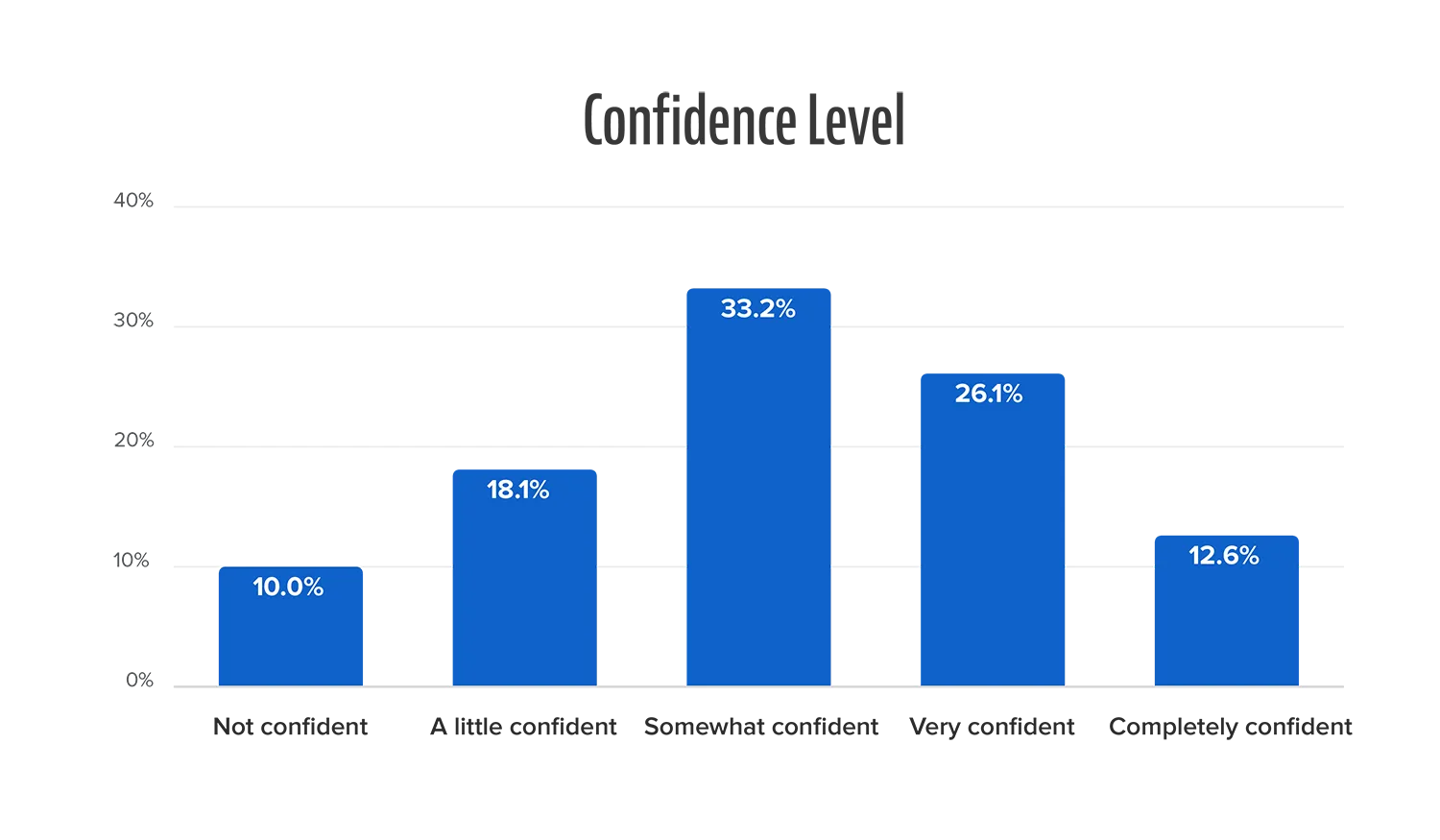
Source: Essential Education learner survey, 602 survey records.
Essential Education learner survey, 602 dashboard records.
71.9% reported feeling somewhat, very, or completely confident about returning to education.
At the same time, 28.1% reported feeling either not confident or only a little confident.
These findings suggest that many adults approach high school equivalency preparation with at least some confidence, even when they have been away from school for years.
However, confidence and academic readiness are not the same.
A learner may feel capable of returning to education while still needing substantial preparation in mathematics, reading, or another subject.
What Would Help Learners Feel Prepared?
The survey also asked what would help adult learners feel more prepared to begin studying.
The most frequently selected resource was a practice or placement test.
44.4% selected a practice or placement test to help them understand where they currently stand academically.
Other common responses included wanting to understand what appears on the exam and having a clear study plan.
These findings suggest that many learners want a better understanding of their current skills and what preparation will involve.
For educators, this reinforces the importance of helping adults identify their starting point and providing clear guidance about the steps needed to prepare for their exams.
Which Subjects Do Learners Expect to Be Most Difficult?
Academic concerns also differ by subject.
| Subject | Responses | Percent |
| Mathematics | 402 | 66.8% |
| Writing | 69 | 11.5% |
| Science | 44 | 7.3% |
| Social Studies | 44 | 7.3% |
| Reading | 43 | 7.1% |
Source: Essential Education learner survey, 602 survey records. Results reflect learners' expectations about which subject will require the most preparation, not actual academic performance.
When asked which subject they expected would require the most preparation, 66.8% of survey records identified mathematics.
Writing was the second most frequently selected subject at 11.5%.
By comparison, reading was the subject learners most frequently identified as an area of confidence, selected by 36.7% of respondents.
These findings reflect learners' expectations and perceptions rather than measured academic performance.
They also reinforce the importance of assessing individual skills rather than assuming that every learner will experience the same academic difficulties.
6. How Quickly Do Learners Hope to Earn Their Credential?
Many adults begin high school equivalency preparation with a completion timeline already in mind.
Among 62,546 Essential Education learners who answered this question, more than half hoped to earn their credential within two months.
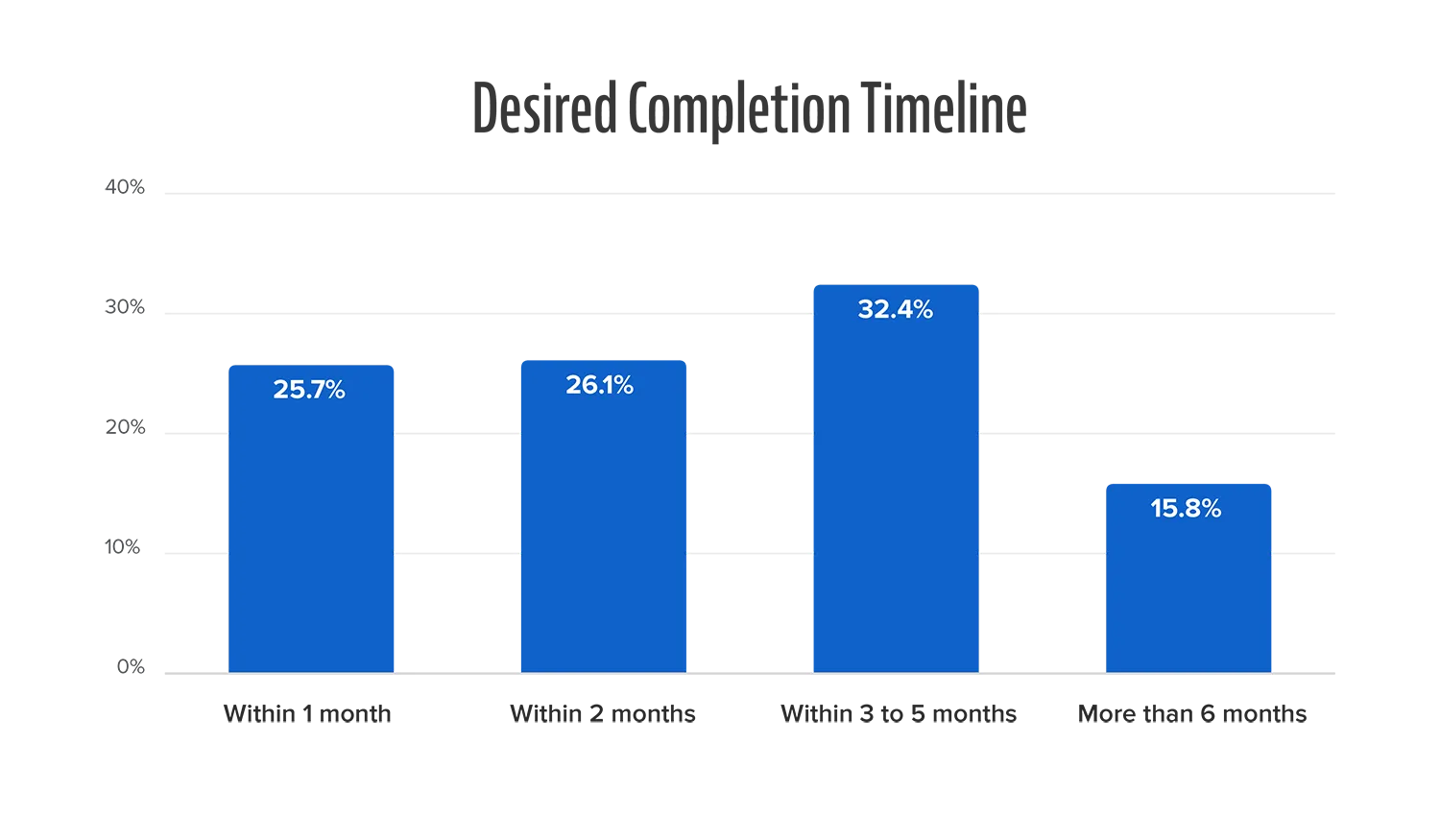
Source: Essential Education learner responses, n = 62,546. These figures represent learners' desired completion timelines, not actual credential completion times.
84.2% hoped to earn their credential within five months.
The findings suggest that many adults want to make progress toward earning their credential relatively quickly.
For some, their desired timeline may be connected to an upcoming job opportunity, college enrollment, career training, or a personal goal.
However, these figures represent learners' expectations rather than actual completion times.
The amount of preparation required depends on several factors, including existing academic skills, study consistency, and individual circumstances.
For adult education programs, understanding learners' timelines can help inform conversations about preparation goals and realistic expectations.
7. How Do GED and HiSET Learners Study?
Understanding how adults use their study time provides another perspective on high school equivalency preparation.
Essential Education analyzed aggregated learner activity across four consecutive weeks, from September 14 through October 11, 2026.
| Weekly study activity | Average per active learner |
| Study sessions per week | 2.98 |
| Study days per week | 2.30 |
| Study hours per week | 2.64 |
| Average study sessions length | 71.7 minutes |
| Median study session length | 52.8 minutes |
Source: Essential Education aggregated learner activity, September 14 to October 11, 2026. Figures reflect observed study activity among active learners, not recommended study schedules or actual credential completion times.
The findings show that active learners generally returned to their studies multiple times during the week.
On average, active learners completed 2.98 study sessions per week, spending approximately 2.64 hours studying.
Study activity occurred throughout the day, demonstrating that adults access educational resources at a variety of times.
The analysis also found that study sessions varied in length, with many learners spending more than half an hour studying during an individual session.
These findings provide a view of how adults engage with online high school equivalency preparation. They describe observed activity rather than a recommended study schedule or a measure of how long it takes to earn a credential.
Technology and Access
Access to technology plays an important role in how adults prepare for their GED or HiSET exams. Essential Education's latest learner survey found that 59.1% of respondents used a computer as their primary study device, while 36.4% primarily used a smartphone or tablet.
Internet access was also an important factor. Among 602 survey records, 91.5% reported having reliable internet access either always or most of the time. However, 8.5% reported having reliable access only some of the time or not at all.
These findings show that while most learners have access to computers and reliable internet, a substantial number rely on mobile devices, and some face connectivity challenges that may affect their ability to study consistently.
For adult education programs, this highlights the importance of providing learning resources that work across different devices and accommodate varying levels of technology access.
8. What Comes After Earning a GED or HiSET?
For many adults, earning a high school equivalency credential is connected to another education or career goal.
Essential Education asked learners who reported passing their high school equivalency exam what they hoped to do next.
| Next education or career goal | Responses | Percent |
| Got to college | 367 | 30% |
| Find a better job | 222 | 18.2% |
| Enter a new career program | 136 | 11.1% |
| Get a promotion at current job | 45 | 3.7% |
| Not sure yet | 453 | 37% |
| Total | 1,223 | 100% |
Among 1,223 responses, 63.0% identified a specific education or career goal.
College was the most frequently selected next step, followed by finding a better job and entering a career program.
At the same time, 37.0% were still deciding what they wanted to pursue.
These findings suggest that while many adults have a clear goal in mind, others may benefit from additional information about education and career opportunities after earning their credential.
How Quickly Do Learners Want to Take Their Next Step?
Essential Education's latest survey also asked adults how soon they hoped to begin their next education or career step after earning their GED or HiSET.
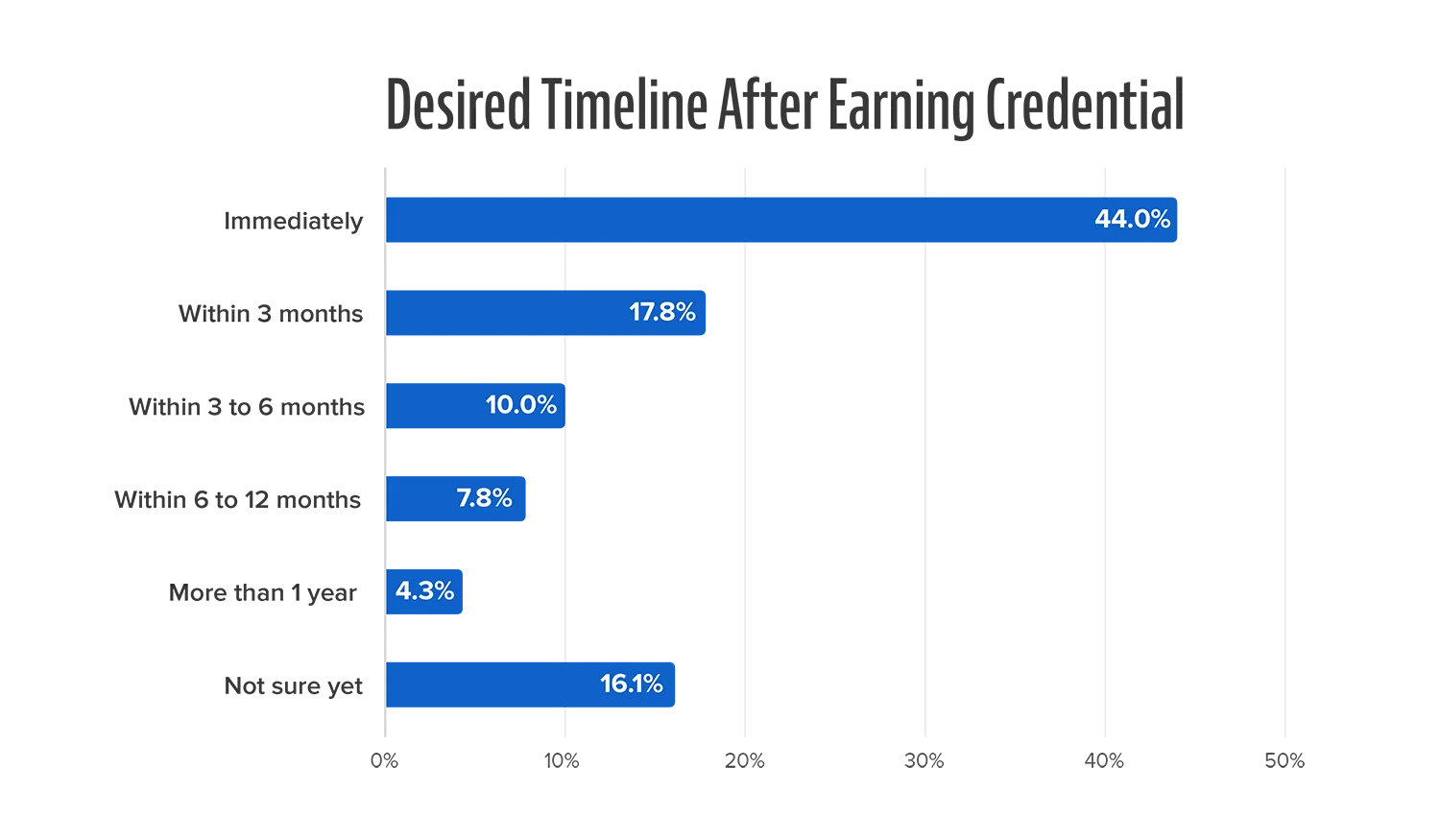
61.8% hoped to begin immediately or within three months.
This included 44.0% who wanted to begin their next step right away.
The findings show that many learners are already thinking beyond their high school equivalency exam while preparing for it.
For some, earning the credential may be connected to a specific employment opportunity or upcoming college enrollment period. For others, it may be the first step toward exploring new possibilities.
The Connection Between Education and Employment
Employment is an important part of the high school equivalency learner experience.
Among 602 survey records,
57.3% reported working full-time or part-time while preparing for their GED or HiSET.
27.9% were not employed but were actively looking for work.
These findings show that high school equivalency learners have different relationships with the workforce.
Some are preparing to enter employment, while others hope to qualify for better positions, advance in their careers, or pursue additional education.
The survey also found that college, employment, and career training were among the most common priorities learners identified after earning their credential.
Together, these findings demonstrate the close relationship between high school equivalency education and learners' plans for their professional futures.
9. What the Research Means for Adult Education
The findings in this report provide a closer look at the experiences, challenges, and goals of adults preparing for GED and HiSET exams. They also offer several important considerations for educators and organizations supporting high school equivalency learners.
Learners Begin From Different Starting Points
Some adults have recently attended school, while others are returning after many years. A substantial portion have also attempted to earn their credential before.
Among Essential Education learner responses, 70.8% indicated they had either not started studying or had studied only a little.
These findings reinforce the importance of understanding each learner's educational background, existing skills, and current level of preparation.
Rather than assuming all adults need the same instruction, programs can use assessments and individualized learning plans to help identify appropriate starting points.
Academic Preparation Is Only Part of the Experience
Time away from school, confidence, employment responsibilities, access to technology, and uncertainty about where to begin can all influence a learner's preparation.
Nearly half of learners who identified their biggest challenge selected having been out of school for a long time.
At the same time, the latest survey found that 71.9% felt at least somewhat confident about returning to education.
These findings show that learners may feel capable of returning to school while still needing academic guidance and support.
Adult education programs can help address these needs by providing clear information, accessible instruction, and opportunities for learners to recognize their progress.
Learners Need Clear Information About Their Preparation
Many adults want to understand what they already know, what the exam requires, and how much preparation they may need.
In Essential Education's latest survey, a practice or placement test was the most frequently selected resource that respondents said would help them feel prepared to begin studying.
This finding highlights the value of helping learners understand their academic starting point before beginning instruction.
Clear expectations, appropriate assessments, and individualized preparation can help adults make informed decisions about their studies.
Education and Career Goals Are Closely Connected
Employment, college, career training, financial stability, and personal accomplishment appear throughout Essential Education's research.
Among learners who reported passing their high school equivalency exam, 63.0% identified a specific education or career goal they wanted to pursue next.
The latest survey also found that 61.8% hoped to begin their next education or career step immediately or within three months of earning their credential.
These findings suggest that adult education programs have an opportunity to support learners not only in preparing for their exams but also in understanding the education and career pathways available afterward.
Looking Ahead
This report establishes a starting point for Essential Education's ongoing research into the experiences of GED and HiSET learners.
Future editions will continue examining changes in learner demographics, educational experiences, academic confidence, preparation needs, study behaviors, and education and career goals.
By following these findings over time, Essential Education aims to contribute original research that helps educators, workforce organizations, researchers, and policymakers better understand the adults they serve.
For learners, earning a high school equivalency credential is an important achievement. Understanding the experiences that lead to that accomplishment can help more adults reach their goals and prepare for what comes next.
10. About the Research
The 2027 Essential Education GED & HiSET Learner Report presents original research based on aggregated data collected through Essential Education's learning programs, website, and direct learner surveys.
The report combines several sources of information to examine the educational experiences, preparation habits, challenges, and future goals of adults pursuing high school equivalency credentials.
Research Sources
Essential Education Learner Responses
Aggregated responses collected through Essential Education's GED Academy and HiSET Academy learning programs over multiple years, with sample sizes varying by question. These responses provide information about learners' motivations, previous attempts, preparation stages, challenges, and desired completion timelines.
2026 Learner Survey
Conducted in October 2026, this survey gathered responses from current and prospective adult learners about their educational experiences, confidence, preparation needs, employment, technology access, and future goals.
Learner Study Activity
Aggregated learning activity recorded between September 14 and October 11, 2026, providing information about study frequency, duration, and participation patterns.
Essential Education Website Data
Aggregated website activity used to understand how adults access Essential Education's online resources.
Research Methodology
The report draws on multiple datasets collected at different points in time. Sample sizes vary depending on the question, the source of the information, and the period analyzed.
The new learner survey included 602 unique respondents. Percentages presented from the survey are based on those displayed records unless otherwise indicated.
For questions allowing multiple responses, percentages represent the proportion of survey records selecting an option and may total more than 100%.
The research includes self-reported information about learners' experiences, confidence, goals, and anticipated challenges. These responses reflect participants' perceptions and expectations rather than independently measured academic performance or future outcomes.
Study activity findings are based on recorded participation within Essential Education's learning programs during the specified four-week period. They describe observed learning activity and should not be interpreted as recommended study schedules or measures of credential completion.
The research includes Essential Education learners from across the United States, along with current and prospective adult learners who participated in the October 2026 survey. The findings reflect the experiences, perspectives, and study behaviors of these participants and provide valuable insight into adults preparing for GED and HiSET credentials.
The purpose of this report is to share original findings that contribute to a better understanding of adult learners and provide useful information for educators, workforce organizations, researchers, and others supporting high school equivalency education.
11. About Essential Education
Founded in 2002, Essential Education develops educational programs and resources that help adults build academic skills, prepare for high school equivalency exams, and pursue additional education and career opportunities.
Essential Education has served more than 4.5 million adults through its online learning programs and instructional materials.
Our programs support GED and HiSET preparation, adult basic education, digital literacy, and workforce readiness.
Essential Education's adaptive learning technology identifies learners' existing skills and areas where additional instruction is needed, helping create personalized learning paths that focus on individual academic needs.
We work with adult education providers, workforce organizations, correctional education programs, and adults studying on their own.
Through our educational programs and ongoing research, Essential Education is committed to helping more adults develop the skills, confidence, and opportunities needed to achieve their education and career goals.
To learn more about Essential Education and our research, visit www.essentialed.com.